A house fire can change a Pensacola property in minutes, but the damage does not stop where the flames stop. Smoke and soot can move through hallways, rooms, attic spaces, and mechanical systems. Water used by firefighters or sprinklers may soak drywall, flooring, insulation, cabinets, framing, and belongings. Along Florida's Gulf Coast, warm, humid conditions can make that added moisture another part of the restoration process.
Homeowners usually have many questions once the fire department leaves. What can be saved? Who should inspect the property? How does smoke cleanup work? What will restoration cost, and what information will the insurance company need? Commercial property owners, managers, insurance agents, adjusters, carriers, and referral partners face many of the same questions, often while trying to keep other people informed.
Rytech Restoration of Greater Pensacola provides 24/7 emergency fire and smoke damage restoration for homes and businesses throughout Pensacola and surrounding Northwest Florida communities. The local team combines IICRC-certified and trained technicians with Rytech's more than 30 years of property restoration experience. Current Rytech service standards also include insurance collaboration, direct billing when applicable, daily job monitoring, empathetic customer care, and a certified technician response within four hours or less after speaking with a live Rytech specialist.
Knowing what happens next gives property owners a clearer path forward.
What Are Common Causes of Fire Damage in Pensacola Homes?
Cooking deserves a place at the top of any Pensacola fire-prevention conversation. The Pensacola Fire Department identifies cooking as the greatest cause of home fires and reports that cooking accounts for 36% of home fire injuries. Unattended cooking is a leading factor, and the department recommends staying in the kitchen while using the stovetop and keeping combustible materials away from cooking areas.
Electrical problems, heating equipment, candles, grills, smoking materials, appliances, and other ignition sources can also start residential fires. Garages and utility areas can present different risks because electrical equipment, stored materials, fuels, tools, and heat sources may occupy the same space.
Pensacola's building stock makes every loss different. Restoration technicians may encounter older wood-framed homes, brick and masonry construction, drywall assemblies, slab foundations, newer subdivisions, apartments, condominiums, vacation properties, and commercial buildings. Properties near Pensacola Beach, Gulf Breeze, Perdido Key, and other coastal communities may bring additional considerations related to Gulf Coast weather, humidity, salt air, and storm exposure.
Holden LeBlanc brings hands-on restoration experience to those conditions. Before becoming a Rytech franchise owner, he worked as a water restoration technician. He has since earned IICRC certifications in Fire & Smoke, Odor, Applied Microbial Remediation, Applied Structural Drying, and Water Damage Restoration, along with OSHA General Industry Safety and Health training.
“Working throughout Pensacola and the Gulf Coast teaches you to look beyond the area that appears damaged first. Our team encounters wood framing, drywall, masonry, slab foundations, tile, finished flooring, coastal properties, multifamily buildings, and commercial facilities, and those materials do not all respond the same way to fire, smoke, soot, or firefighting water. My background as a restoration technician and IICRC training in Fire & Smoke, Odor, Applied Structural Drying, Water Damage Restoration, and Applied Microbial Remediation shape how we approach these losses. We follow the damage, document what we find, and look for opportunities to restore affected materials before unnecessary removal.”
Holden LeBlanc, Owner, Rytech Restoration of Greater Pensacola
That combination of local knowledge and technical training matters because a kitchen fire in Pensacola may create a very different restoration project than an electrical fire in a commercial building or a smoke loss at a coastal condominium.
What Should I Do Immediately After a Fire?
Personal safety comes first. Leave the building, account for everyone, and follow instructions from Pensacola Fire Department, Escambia County Fire Rescue, or other emergency personnel responding to the property. Re-entry should follow the direction of the authorities handling the scene.
After the property has been released, contact your homeowners insurance provider and a professional restoration company. Photographs, video, inventories, receipts, and records of affected belongings can help establish the property's post-fire condition.
Resist the urge to start aggressively wiping soot from walls, cabinets, ceilings, furniture, or electronics. Fire residues vary according to what burned, and cleaning methods suitable for one surface may spread or embed residues on another. Carrying soot-covered belongings through unaffected areas can also transfer contamination.
Professional assessment creates a logical starting point. Rytech's fire response begins with an assessment and recovery plan before restoration work proceeds. The company's current Greater Pensacola service model provides live 24/7 emergency contact and states that an IICRC-certified technician can arrive within four hours or less after that initial conversation.
How Is Fire Damage Assessed and Inspected?
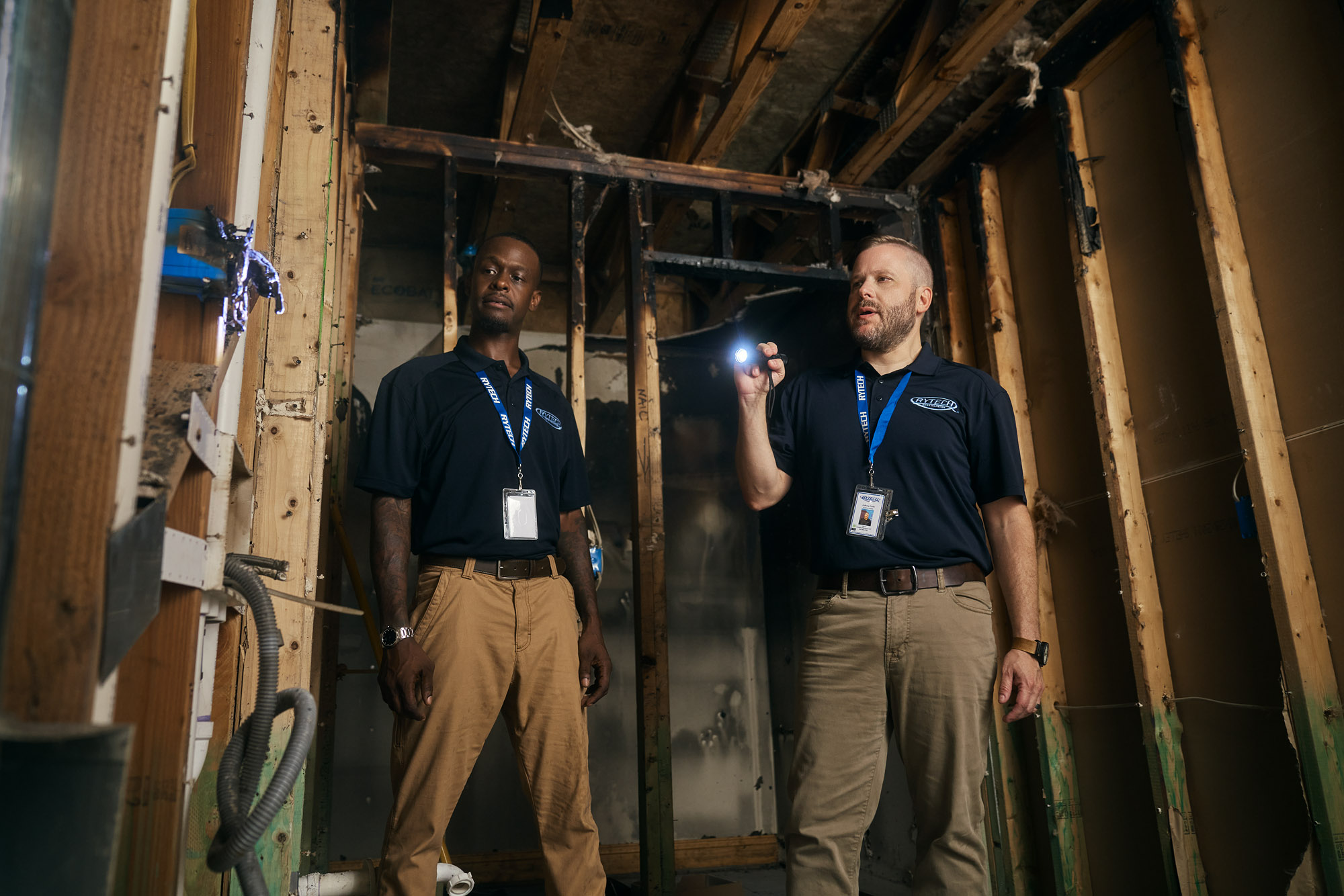
A professional fire inspection follows the damage rather than stopping at the room where flames were visible. Technicians consider heat exposure, smoke distribution, soot, odors, contents, building materials, possible HVAC involvement, and water introduced while extinguishing the fire.
Consider a kitchen fire in an Escambia County home. Flames may remain around the cooking area while smoke moves into adjoining rooms and down a hallway. At the same time, firefighting water can move underneath cabinets, across flooring, through wall assemblies, or into rooms below.
Water migration requires measurement. ANSI/IICRC S500 calls for an initial moisture inspection to identify affected assemblies and materials and determine the edge of water migration. Inspection continues outward from the source until the extent has been identified and documented. Adjoining spaces can also require inspection because water may travel underneath walls or from areas above.
Professional equipment can help technicians find those conditions. Thermal imaging can show apparent surface-temperature differences associated with possible moisture, while moisture meters verify and document moisture conditions. The combination provides more useful information than relying on appearance or touch alone.
Documentation connects those findings with the restoration plan. Photographs, moisture readings when applicable, affected-area records, contents information, and project notes give homeowners, property managers, agents, adjusters, and insurance carriers a shared picture of the loss.
How Do I Start an Insurance Claim for Fire Damage?

Contact your insurance company or agent and report the fire. Provide the date, basic details about what happened, and information about the areas and belongings that appear affected. Your insurance professional can explain the deductible, limits, coverage provisions, and procedures associated with your policy.
Next comes documentation. Photographs, videos, inventories, receipts, and information about damaged belongings can support the claim record. Professional restoration documentation can add inspection findings, moisture measurements when relevant, photographs, affected materials, and records showing how restoration progresses.
Most Pensacola homeowners do not manage property claims every day. Insurance agents, adjusters, carriers, and restoration professionals do, so having experienced people explain each part of the process can make an unfamiliar situation easier to understand.
Rytech works with insurance companies and provides direct insurance billing when applicable. Its fire restoration model also includes daily job monitoring and regular communication, which helps keep property owners and insurance professionals informed as conditions change.
For commercial losses, documentation becomes even more valuable. Owners and property managers may be coordinating occupants, employees, inventory, operations, vendors, insurance professionals, and restoration work at the same time.
What Is the Difference Between Professional Fire Damage Restoration and DIY Cleanup?
A black mark on a wall may look like ordinary dirt. Fire residue behaves differently.
The material that burned influences the soot left behind. Cooking oils, wood, plastics, fabrics, electronics, and other materials can create different residues. Painted drywall, finished wood, tile, masonry, metal, carpet, upholstery, and electronics can also react differently to cleaning.
Professional restoration matches the cleaning procedure to both the residue and the material. Fire restoration guidance supports beginning with methods appropriate for the affected surface rather than immediately choosing an aggressive cleaning procedure.
The larger difference involves scope. A homeowner may focus on a smoky wall while a trained restoration technician is considering adjoining rooms, contents, odors, HVAC pathways, firefighting water, and concealed spaces at the same time.
Rytech takes a restoration-first approach. Technicians evaluate affected materials to determine what can be successfully cleaned, dried, and restored before unnecessary demolition occurs. Materials that are beyond restoration can then be documented and removed as part of the mitigation process.
What Does Fire Damage Restoration Typically Cost?
There is no single Pensacola fire restoration price because fire losses vary dramatically. A small cooking incident with limited smoke can require a very different scope than a fire involving several rooms, contents, structural materials, soot, odor, and firefighting water.
Current 2026 national consumer data from Angi places average fire damage restoration costs at approximately $27,477, with most projects ranging from about $3,083 to $52,031. Water damage associated with a fire is estimated at approximately $1,000 to $6,000, while soot removal is estimated at approximately $2,000 to $6,000.
The same 2026 dataset reports a Florida average of approximately $64,900, reflecting geographic differences in labor-intensive restoration costs. That statewide figure does not represent a quote for a Pensacola property. An inspection of the individual loss provides a much more useful basis for determining scope and cost.
Affected square footage, fire type, soot conditions, moisture, contents, accessibility, odor treatment, labor, and specialty evaluations can all change the final scope. Restoration potential matters too. Successfully preserving a material through professional cleaning or drying can reduce unnecessary demolition.
Insurance compensation depends on the individual policy and covered loss. Your agent or carrier can explain how dwelling coverage, personal property coverage, deductibles, limits, and other provisions apply to your claim.
How Are Smoke and Soot Removed After a Fire?
Professional smoke restoration starts by figuring out where residues traveled. Flames may remain in one room while smoke reaches hallways, bedrooms, closets, attics, or other connected areas.
Technicians then evaluate the residue and the surface beneath it. A cleaning process appropriate for finished wood may not be appropriate for painted drywall, upholstery, masonry, metal, or another material.
Loose particles can require HEPA-filtered vacuuming, while other residues may require more detailed surface cleaning. Fire and wildfire restoration guidance supports progressing from less aggressive cleaning methods toward more aggressive procedures when conditions require them. The goal is effective cleaning without causing unnecessary damage to materials that can be restored.
Mechanical systems may also warrant evaluation when smoke has entered the air-distribution system. Fire-related particles can move through ductwork and reach areas beyond the immediate fire zone.
Rytech Restoration of Greater Pensacola provides professional fire and smoke damage restoration in Pensacola for homes, businesses, rental properties, and other affected buildings. The local fire service includes smoke and soot cleanup, structural drying, odor treatment, and contents services.
How Are Smoke Odors Removed?
Smoke odor is often a clue. When a room looks clean but still smells like the fire, residues or odor sources may remain on surfaces, contents, porous materials, or less visible areas.
Professional deodorization works alongside cleaning rather than simply covering the smell with fragrance. Fire restoration guidance focuses on removing or addressing odor sources as part of the restoration process.
The exact method depends on what burned, how much smoke was produced, and where it traveled. Surface cleaning, air filtration, ventilation, contents treatment, and professional deodorization techniques may become part of the restoration plan.
Holden LeBlanc's IICRC Odor certification is particularly relevant to this part of a Pensacola fire loss. Fire and smoke restoration requires understanding why the odor remains before selecting the method used to address it.
A useful question for a homeowner is simple: If the visible soot is gone but the smoke smell remains, where else did the fire residue travel?
What Happens When Firefighting Water or Sprinklers Soak the Property?
The water that controls a fire can create a second restoration challenge. Fire hoses and sprinkler systems may wet drywall, flooring, insulation, cabinets, framing, ceilings, furniture, and other contents.
That water does not always remain visible. Moisture can move beneath flooring, through walls, into cabinets, or downward into spaces below. ANSI/IICRC S500 calls for restorers to determine the extent of water migration rather than assuming the visible wet area represents the entire loss.
Once affected materials have been identified, technicians establish drying goals. S500 defines these goals as target moisture levels established by a qualified restorer. Moisture measurements gathered during drying show whether affected materials are making progress toward those goals.
Pensacola's Gulf Coast climate makes moisture control especially relevant. Local Rytech guidance identifies high humidity, tropical weather, and coastal conditions among the property challenges encountered throughout the region.
Professional drying therefore relies on measurements and drying science rather than simply waiting for surfaces to feel dry.
What Happens if Mold Develops After Fire Sprinkler Use?
Moisture from sprinkler discharge or firefighting operations can reach hidden spaces. Drywall, insulation, flooring, cabinets, framing, and building cavities may remain damp after visible water has been removed.
When mold contamination is present, ANSI/IICRC S520 provides a framework for evaluating affected materials. Factors include porosity, the ability of a material to support fungal growth or hold spores, and its structural integrity.
Containment can help separate the remediation area from unaffected parts of the building. Depending on project conditions, professional remediation may use source, local, or full-scale containment along with HEPA-filtered air filtration as part of the engineering controls.
Physical removal is central to professional mold remediation. The work focuses on containment, removing mold contamination, cleaning appropriate materials, and reducing harmful mold spores in the indoor environment.
Rytech Restoration of Greater Pensacola provides both water damage restoration and mold remediation alongside fire restoration. That combination can help when one fire event creates several connected property conditions requiring professional attention.
How Is Structural Damage Handled After a Fire?
Heat can affect framing, roofs, floors, walls, and other structural components. The degree of change depends on the material, temperature, duration of exposure, and proximity to the fire.
Pensacola-area properties can include wood framing, masonry, concrete slabs, steel components, drywall assemblies, elevated coastal construction, and other building systems. Each material reacts differently when exposed to heat and fire.
Fire restoration guidance recognizes wood, steel, concrete, and masonry as common structural materials and directs restorers to recognize evidence of heat or fire effects that may have compromised structural components. When those conditions require specialized analysis, an engineer or other appropriately qualified professional can become part of the recovery process.
Rytech's role centers on mitigation and restoration. Technicians identify affected materials, restore materials that can be successfully saved, and remove those that are beyond restoration. Structural engineering, electrical, roofing, HVAC, and other specialty work can be handled by qualified professionals in those disciplines when the property conditions call for them.
This approach prevents a common assumption after a fire: proximity to flames does not automatically mean every nearby material needs to come out. Actual condition and restoration potential should guide that decision.
Can Personal Belongings Be Saved After Fire Damage?
A smoky room does not automatically mean everything inside has been lost. Furniture, clothing, décor, household goods, business inventory, and other contents can be evaluated according to their material, heat exposure, soot, odor, moisture, value, and ability to respond to cleaning.
Some items can be treated at the property. Others may benefit from professional packout so selected belongings can be documented and moved while structural restoration proceeds.
Packouts can also give technicians better access to affected floors, walls, cabinets, and other building materials. On larger residential and commercial losses, separating contents work from structural restoration helps organize a complicated project.
Rytech's fire restoration program includes contents packout services. Company guidance describes carefully cataloging, cleaning, and storing affected items during restoration.
Documentation helps here too. A detailed contents record gives homeowners and insurance professionals useful information about which belongings were affected and how they were handled.
What Health and Safety Conditions Can Remain After a Fire?
Putting out the flames ends one emergency, but the property may still contain several forms of damage. Smoke and soot residues can remain on materials, heat may have affected building components, electrical systems may require evaluation, and firefighting water can remain hidden inside assemblies.
The affected area can also be larger than expected. Smoke may move upward or through connected spaces, while water may travel downward or beneath walls and flooring.
Commercial buildings introduce another level of complexity. Hotels, restaurants, offices, retail properties, multifamily housing, vacation properties, and other Northwest Florida facilities can have larger mechanical systems, numerous occupants, inventory, and several connected spaces.
Instead of asking only, “Where did the fire burn?”, ask a broader question:
“Where did the heat, smoke, soot, odor, and water travel?”
That question better reflects the way a professional restoration inspection approaches the property.
How Long Does Fire Damage Restoration Usually Take?
A small smoke-cleaning project can move much faster than a loss involving multiple rooms, contents, structural drying, heavy soot, odor treatment, and specialty evaluations.
Current 2026 consumer data from Angi reports an average overall fire restoration timeline of approximately four months, with projects ranging from around two weeks to 12 months depending on severity. The broader property recovery period can include specialty work beyond Rytech's mitigation and restoration scope.
Affected square footage, soot conditions, moisture, contents processing, access, and material condition can influence the restoration timeline. Previously concealed smoke or moisture can also affect the scope once technicians gain access to additional areas.
Insurance coordination is another part of the broader recovery schedule. Detailed records and communication help homeowners, property managers, adjusters, carriers, and restoration professionals understand what has been completed and what comes next.
Rytech's service model includes daily job monitoring and regular project updates. That creates a documented picture of restoration progress rather than leaving property owners to guess where the project stands.
How Do I Choose a Fire Damage Restoration Company in Pensacola?
Start by looking at training and credentials. Ask whether technicians have IICRC certification and whether the company regularly handles fire, smoke, soot, odor, water, mold, and contents losses.
Then ask how the company investigates damage. How will technicians determine where smoke traveled? How will firefighting water be located? What equipment will be used to measure moisture? How will materials be evaluated for restoration before removal?
Insurance coordination and documentation deserve attention as well. Homeowners and property managers should understand what technicians found and what work is being performed. Agents, adjusters, and carriers benefit from clear project records for the same reason.
Rytech Restoration of Greater Pensacola provides 24/7 emergency response, IICRC-certified and trained technicians, licensed, bonded and insured service, insurance collaboration, direct billing when applicable, daily job monitoring, empathetic customer care, and pricing based on industry standards. The local team is backed by Rytech's more than 30 years of property restoration experience.
Holden LeBlanc adds restoration field experience and multiple IICRC credentials covering Fire & Smoke, Odor, Applied Microbial Remediation, Applied Structural Drying, and Water Damage Restoration. For Pensacola property owners, that cross-disciplinary background matters because a single fire can create smoke, odor, water, contents, and microbial concerns at the same property.
How Can Pensacola Homeowners Reduce Future Fire Damage?
Start in the kitchen. Pensacola Fire Department identifies cooking as the greatest cause of home fires and reports that it accounts for 36% of home fire injuries. Stay in the kitchen while using the stovetop, monitor food during longer cooking, and keep combustible materials away from heat.
Working smoke alarms add another layer of protection. Escambia County Fire Rescue recommends alarms in appropriate locations throughout the home and replacing smoke alarms when they reach 10 years of age. The county also operates a program that provides and installs free smoke alarms for residents who need them.
Pensacola residents have a similar local resource. Pensacola Fire Department offers smoke alarm installation assistance for city residents. These programs give homeowners a practical way to turn fire-prevention advice into action.
Create a home escape plan as well. Escambia County recommends identifying at least two ways out of each room when possible and making sure doors and windows used for escape open easily.
Finally, review your homeowners insurance policy periodically and keep a current home inventory. Photos or video of rooms and major belongings can provide useful records if a future fire affects your Pensacola property.
Get Inspected to Stay Protected After Fire or Smoke Damage in Pensacola

Once firefighters leave, the next stage begins with finding out how far the property damage traveled.
Rytech Restoration of Greater Pensacola serves homeowners, commercial businesses, property managers, insurance professionals, and referral partners throughout Pensacola and Escambia County, along with Northwest Florida communities including Pensacola Beach, Perdido Key, Gulf Breeze, Pace, Milton, Navarre, Fort Walton Beach, Destin, Niceville, Crestview, Santa Rosa Beach, Miramar Beach, Freeport, Panama City, and Panama City Beach, with service extending through Escambia, Santa Rosa, Okaloosa, and Walton counties.
If your home, rental property, commercial facility, or insured property is dealing with fire damage, smoke, soot, odors, sprinkler discharge, firefighting water, hidden moisture, or related mold concerns, call Rytech Restoration of Greater Pensacola at (850) 684-8759. The local team is available 24/7 to answer questions, inspect the damage, and help determine what needs attention next.
GET INSPECTED TO STAY PROTECTED.
FAQs: Answering Your Pressing Fire Damage Repair Questions
At Rytech Greater Pensacola, we understand how overwhelming fire damage can be. To help you during this difficult time, we’ve compiled a list of FAQs. Here, you'll find detailed information about our services, the restoration process, and what you can expect when working with us.


